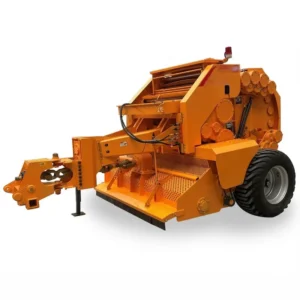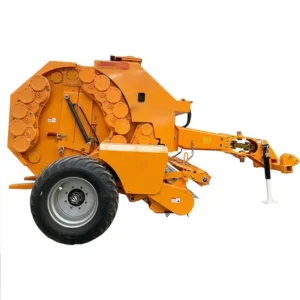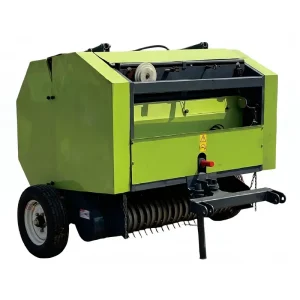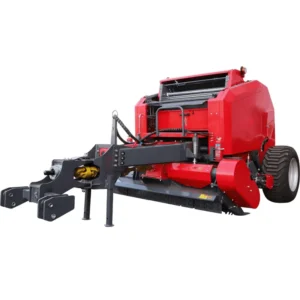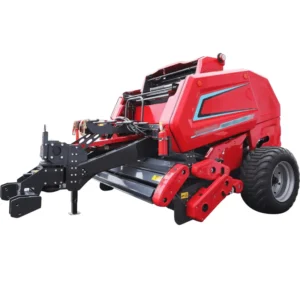
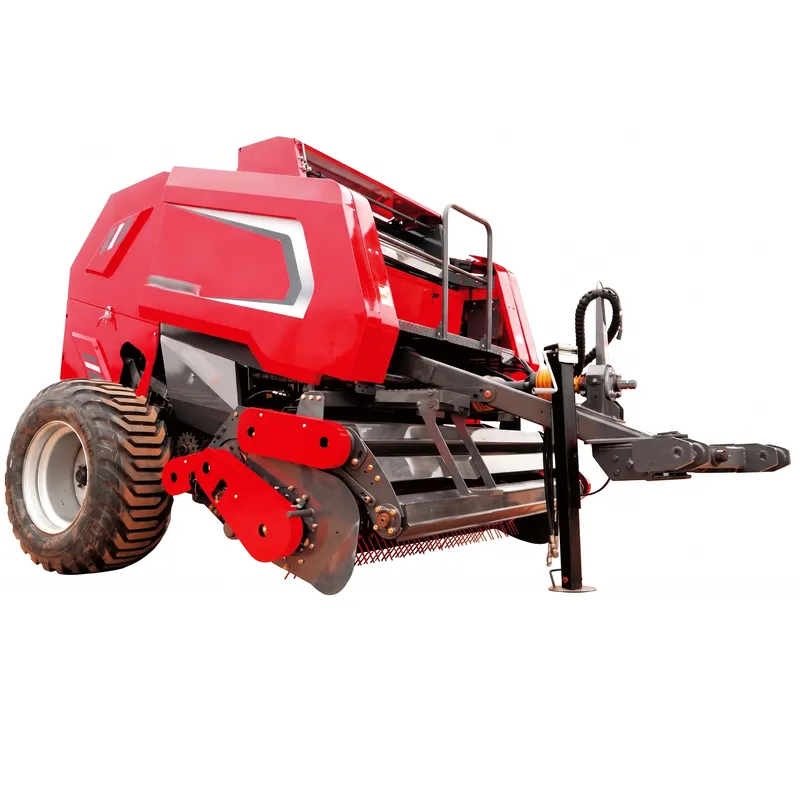
9YG-2.2 Towed-type Round Baler for Tractor
The 9YG-2.2 Towed-type Round Baler is towed directly by a standard farm tractor via the PTO driveline. It excels at collecting and compressing the straw and grass left after harvesting corn, rice, wheat, soybeans, and forage crops, rolling them into firm, uniformly shaped round bales of Phi 1220 mm diameter. Whether you are managing large-scale grain fields or a mixed livestock operation, this round hay baler transforms loose residue into dense, storable bales ideal for animal feed, bedding, bioenergy, or silage wrap.
The 9YG-2.2 Towed-type Round Baler is towed directly by a standard farm tractor via the PTO driveline. It excels at collecting and compressing the straw and grass left after harvesting corn, rice, wheat, soybeans, and forage crops, rolling them into firm, uniformly shaped round bales of Phi 1220 mm diameter. Whether you are managing large-scale grain fields or a mixed livestock operation, this round hay baler transforms loose residue into dense, storable bales ideal for animal feed, bedding, bioenergy, or silage wrap. Its wide 2200 mm picking width and continuous screw feeding mechanism keep material flowing smoothly even in heavy windrows, while the 18-roller drum bale chamber applies even compression throughout the bale for superior shape and density. Farmers looking for a reliable baler that handles corn stalks, wheat straw, and alfalfa without costly downtime will find the 9YG-2.2 a proven answer.
Beyond raw baling power, the 9YG-2.2 is built around intelligent operation. The handheld color touchscreen and dual automatic/manual modes make round baler operation accessible for new operators while giving experienced hands full control. Net wrapping replaces traditional round baler twine with a tight, weatherproof finish, protecting bales stored outdoors for weeks. The fully automatic thin-oil lubrication system, centralized grease points, and globally sourced drivetrain components , bearings, clutch, chain, and electronic control , all contribute to a machine designed for long seasons with minimal workshop time. Whether you are comparing a round baler vs square baler, searching for the right round baler sizes, or simply need a compact baler that matches your mid-size tractor, the 9YG-2.2 delivers performance, precision, and value across all common baling applications.
Product Specifications
| No. | Item | Unit | Specification |
| 1 |
Model Name |
/ |
Model 9YG-2.2 Round Baler |
| 2 |
Hitching Method |
/ | Towed-type |
| 3 |
Picking Width |
mm | 2200 |
| 4 |
Feed Inlet Width |
mm | / |
| 5 |
Picker Structure |
/ | Spring tooth type |
| 6 |
Feeder Structure |
/ |
Continuous Screw Feeding Mechanism |
| 7 |
Type of compressing bale chamber |
/ | Roll drum type |
| 8 |
Width of compressing room |
mm | 1400 |
| 9 |
Diameter of compression |
mm | Φ1220 |
| 10 |
Quantity of Roll - Pressing Working Components |
pc | 18 |
| 11 |
Diameter of Roll - Pressing Roller |
mm | Φ222 |
| 12 |
Bundling Type |
/ | Net wrapping |
| 13 |
Matching power range |
kW | 110 ~ 150 |
| 14 |
Overall Dimension (L×W×H) |
mm | 4100×2900×2400 |
| 15 |
Machine Weight |
kg | 3800 |
Key Features of the 9YG-2.2 Round Hay Baler
1. Touchscreen Precision Control
The handheld color touchscreen controller operates stably and reliably under field conditions. Paired with a high-precision displacement sensor, it enables farmers to set and maintain exact bale weight targets from the cab, eliminating guesswork and reducing bale-to-bale variation to near zero throughout the entire baling cycle.
2. Dual-Mode Operation System
The round baler operation system is designed to be intuitive yet fully capable. Operators can choose between fully automatic mode for hands-free baling cycles or switch to manual mode for precise, step-by-step control in irregular conditions. The entire baling process is monitored on-screen in real time, so equipment status is always clear at a glance without stopping the tractor.
3. High-Precision Net Wrap Positioning
A dedicated high-precision sensor tracks each loop of round baler wrap as it is applied to the completed bale. By accurately counting and controlling net wrapping cycles, the system eliminates over-wrap waste and ensures every bale receives consistent, weatherproof coverage. This targeted approach to round baler wrap usage delivers measurable cost savings over a full baling season.
4. Fully Automatic Lubrication System
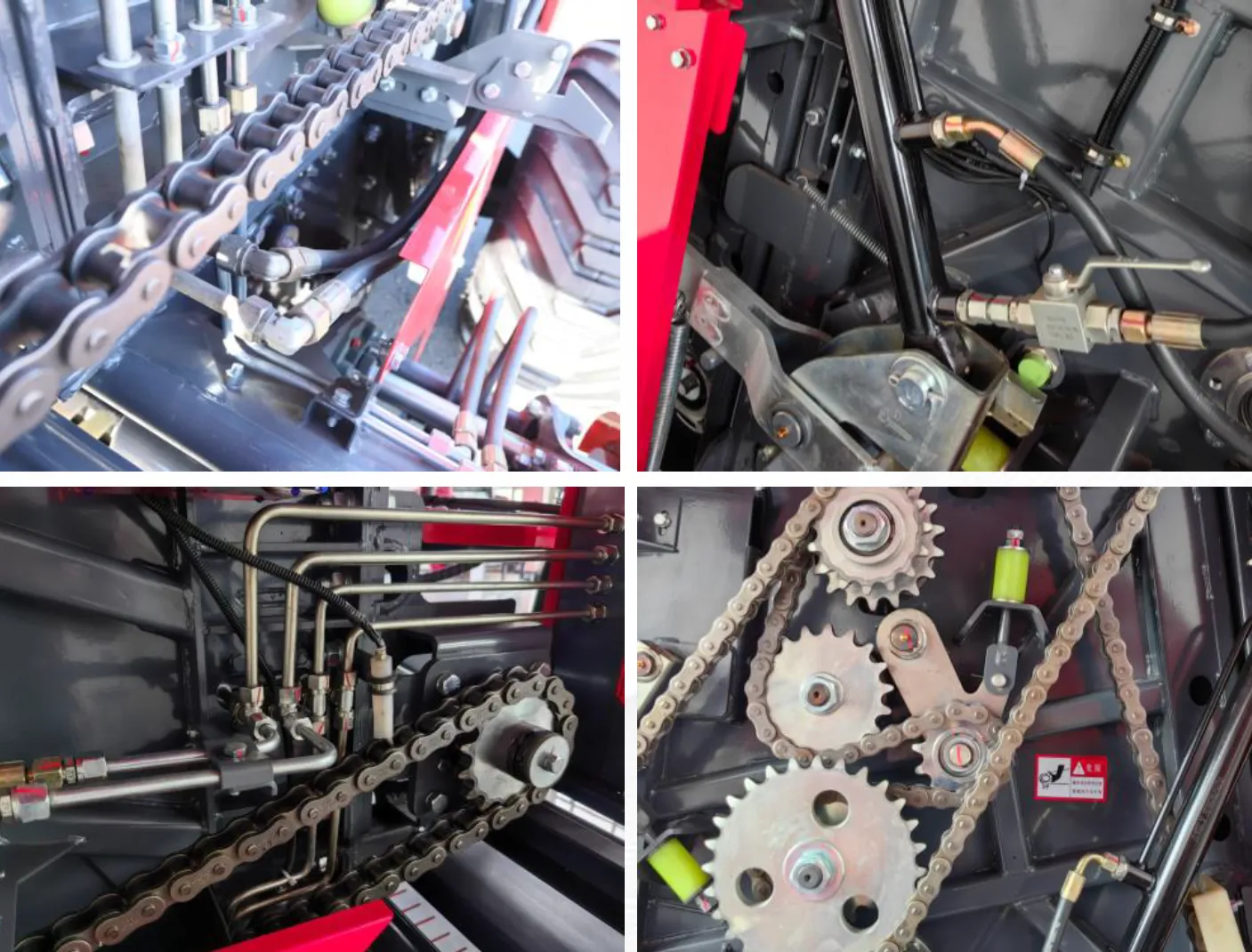
The fully automatic thin-oil lubrication system continuously feeds the entire chain drive network of the round baler machine, preventing premature wear and extending service life significantly. Grease lubrication points throughout the machine are consolidated into a centralized oil supply manifold, so operators can complete all lubrication tasks quickly from a single access point, cutting routine maintenance time during busy harvest windows.
5. Adaptive Hydraulic Pickup System
The hydraulic circuit governing pickup height provides genuine floating action, allowing the spring-tooth pickup reel to follow ground contours automatically as field terrain changes. This adaptive response ensures consistent crop intake even over uneven ground without operator intervention, and the system is designed for simple cleaning and maintenance access, reducing the time spent clearing blockages or servicing the pickup assembly after heavy use.
6. Globally Sourced Premium Components
Every critical component in the 9YG-2.2 is sourced from internationally recognized manufacturers. The round baler PTO shaft, drive bearings, clutch assembly, roller chain, and electronic control module all carry the pedigree of world-renowned brands, resulting in a machine whose overall reliability and longevity far exceed what domestic-only sourcing could achieve. This commitment is reflected in far lower round baler parts replacement frequency over the machine life cycle.
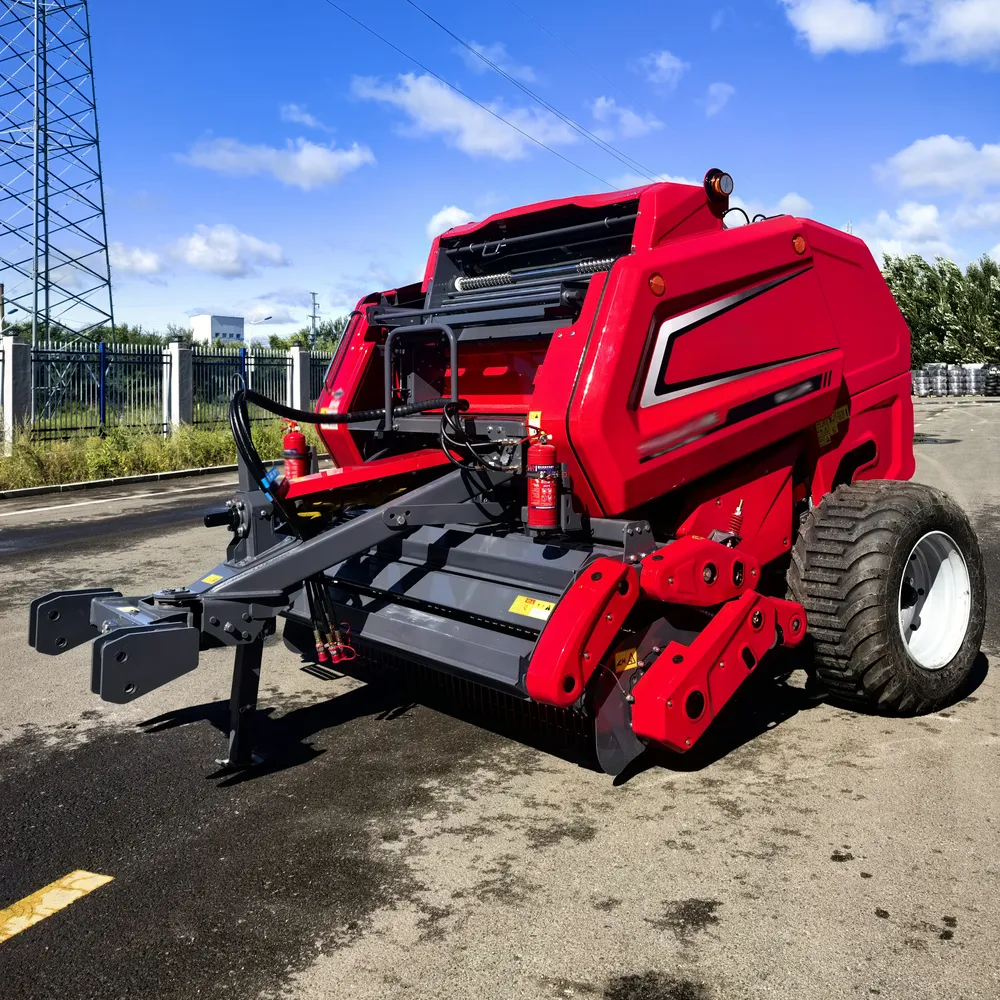
How Does a Hay Round Baler Work?
1. Pickup & Feeding
As the tractor moves forward, the 2200 mm wide spring-tooth pickup reel lifts the swathed crop from the ground, even in damp or tangled material conditions. The spring teeth flex over obstacles without breaking, and the 540 rpm tractor PTO drives the reel continuously. Crop flows rearward and inward via the continuous screw feeding mechanism, which centers the material stream for even chamber fill before it enters the baling zone.
2. Bale Chamber Compression
Material enters the fixed roll-drum bale chamber where 18 counter-rotating rollers of Phi 222 mm diameter apply progressive, radial pressure to the growing bale core. The drum-roll design builds bale density from the outside edge inward, producing uniformly dense round bales that resist deformation during handling and storage. The chamber width of 1400 mm ensures the finished bale is stable for wrapping. The high-precision displacement sensor monitors bale growth and signals the touchscreen when target diameter is reached.
3. Net Wrapping
Once the bale reaches the preset diameter, the control system automatically triggers the net wrapping cycle. Round baler wrap is fed from the roll and drawn across the rotating bale surface, layering evenly as the precision sensor counts each loop. Net wrap binds the bale tightly without the moisture-retention issues sometimes associated with round baler twine, protecting silage and hay from weather damage. The number of wrap cycles is user-configurable to balance protection and round baler wrap material cost.
4. Bale Ejection
After the wrap cycle is complete and the net is severed cleanly, the rear tailgate opens hydraulically and the finished bale rolls down a controlled ramp onto the field surface. The gate closes, the chamber is ready for the next cycle, and the tractor resumes forward movement immediately. In automatic mode, the entire ejection and re-start sequence is executed without the operator leaving the cab, enabling high throughput during peak harvest periods when minimizing cycle time is critical.
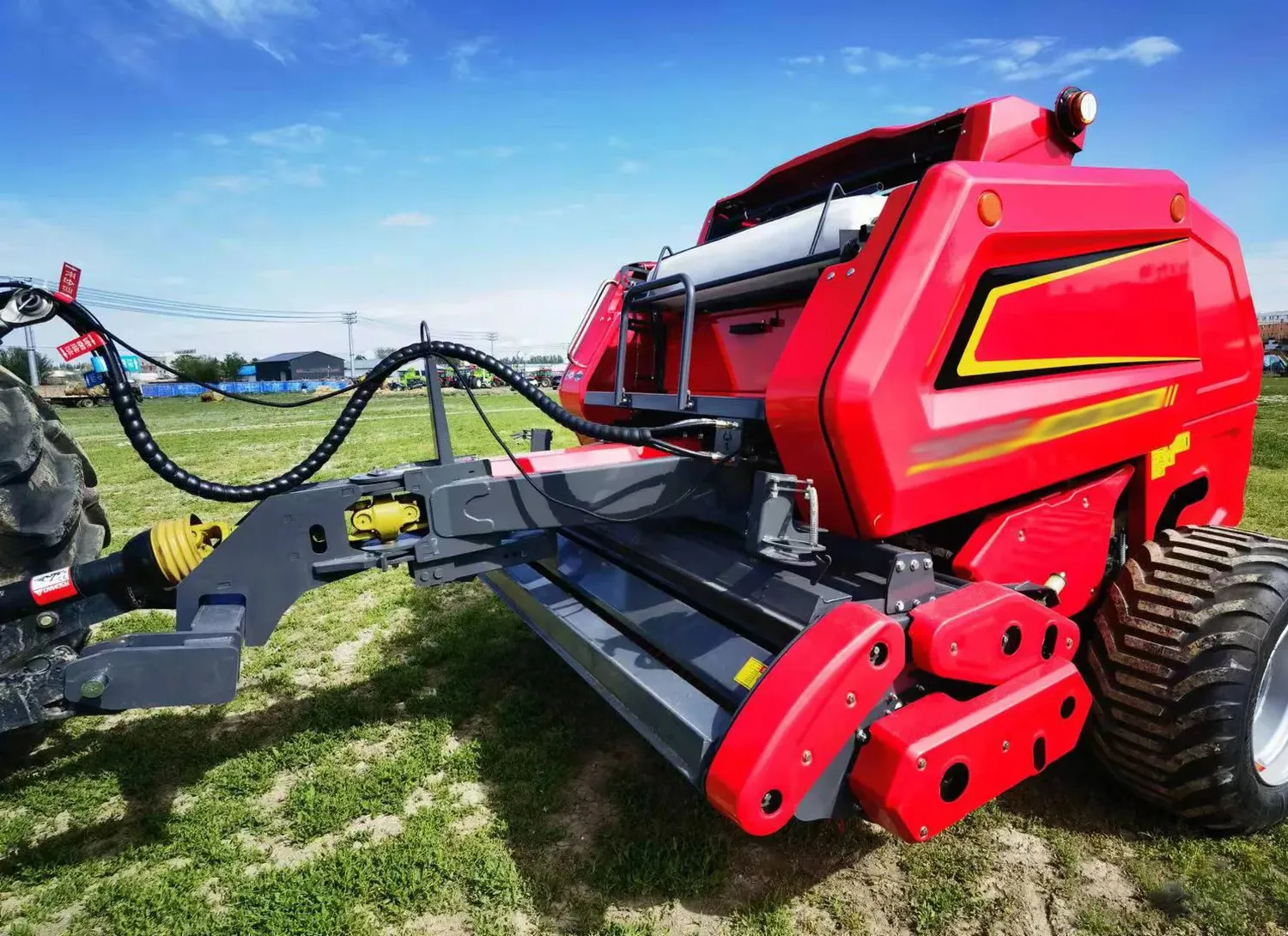
Application Scenarios
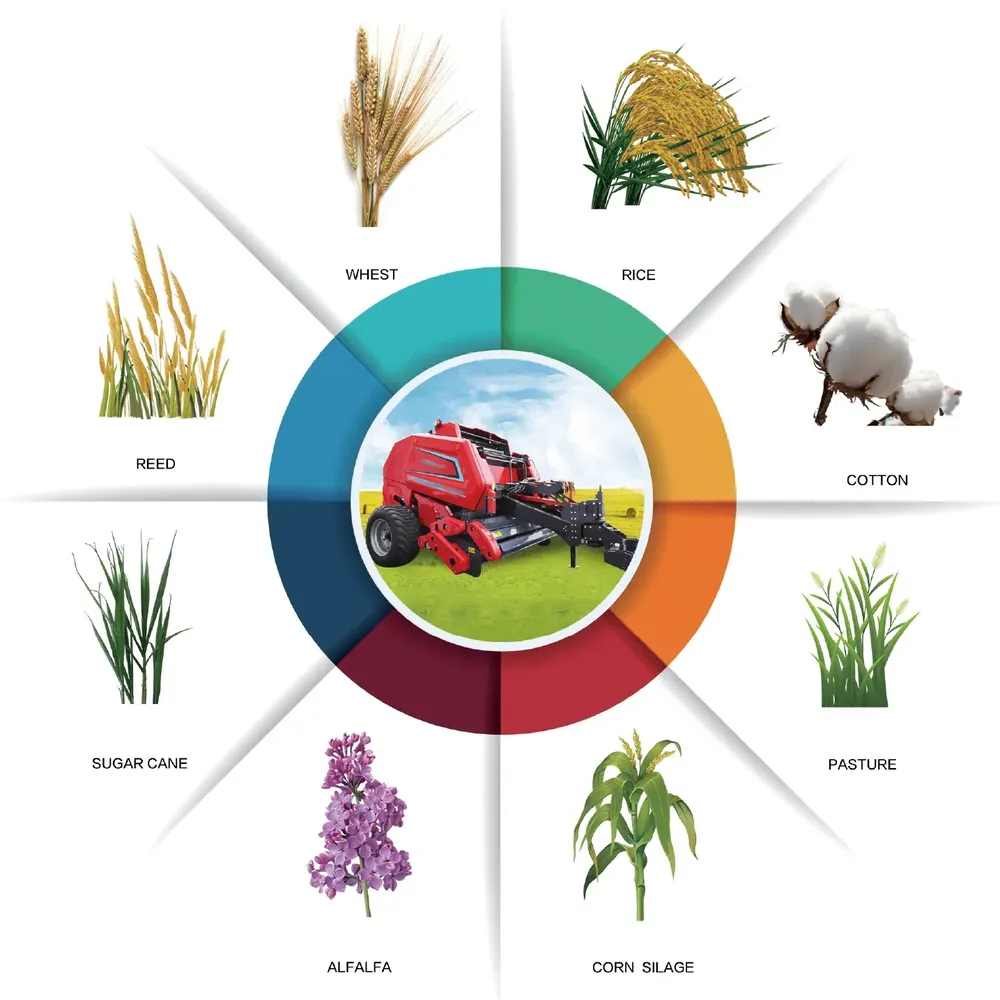
1. Corn Silage
When used for baling corn stalks and whole-crop silage, the 9YG-2.2 handles the high moisture content and coarse stem structure without chamber plugging. The wide 2200 mm picking width gathers corn rows efficiently after the combine passes, and the dense Phi1220 bales are easily stretch-wrapped for anaerobic fermentation, producing high-energy silage ideal for dairy and beef cattle operations during winter feeding seasons.
2. Wheat Straw
Wheat straw is among the most common materials processed by small round hay balers worldwide. The 9YG-2.2 spring-tooth pickup cleanly lifts brittle straw windrows without shattering valuable leaf fraction, and the 18-roller drum chamber packs straw to a density suitable for animal bedding, mushroom substrate, or solid-fuel pellet production. Net wrapping replaces round baler twine for cleaner, longer-lasting bales that shed rain effectively during outdoor field storage.
3. Rice Straw
Rice straw presents unique challenges: high silica content, short fiber length, and often high field moisture after harvest. The 9YG-2.2 continuous screw feeder prevents bridging at the feed inlet, while the hydraulic pickup float absorbs irregular windrow heights common in paddy-field headlands. The resulting bales serve as livestock roughage, composting feedstock, and increasingly as raw material for bio-based packaging and building insulation industries across Asia and Southeast Asia.
4. Cotton Stalks
Cotton stalks are woody and abrasive, demanding a round baler machine with robust roller construction and superior drivetrain protection. The globally sourced bearings and heavy-duty chain system in the 9YG-2.2 resist the accelerated wear that cotton stalks inflict on lighter machines. Baled cotton stalks are increasingly valued as a biomass energy feedstock, and the consistent Phi1220 bale size simplifies logistics for biomass plant receiving operations, improving gate receipts for farm operators growing cotton in arid regions.
5. Pasture Grass
For permanent pastures and grass leys cut for hay, the 9YG-2.2 functions as a true round hay baler for hay, producing tight, uniform bales that store well and are easy to handle with a front loader. The dual auto/manual mode allows experienced operators to match baling speed precisely to grass density and moisture, reducing bale looseness in dry conditions and avoiding chamber overload in heavy first-cut swards. Bales can be net-wrapped immediately for haylage production when moisture is above 30%.
6. Sugarcane Tops and Trash
Post-harvest sugarcane tops and trash biomass represent a significant and often underutilized residue stream across tropical and subtropical regions. The 9YG-2.2 processes leafy, fibrous sugarcane material efficiently, and the sealed, net-wrapped bales are suitable for direct transport to bagasse-fired cogeneration plants. Field trials show that baling sugarcane trash eliminates open burning, reduces soil erosion risk, and yields a saleable co-product from material previously considered an environmental liability.
7. Alfalfa
Alfalfa is the premier forage crop for dairy and equine nutrition, and quality preservation during baling is paramount. The 9YG-2.2 hay round baler controls bale density carefully via the touchscreen weight monitor, ensuring alfalfa bales are dense enough to exclude oxygen without crushing fragile leaf material that carries the majority of crude protein value. Net wrapping protects each bale from rain and UV degradation, allowing multi-cut alfalfa operations to stockpile several cuttings safely across the season.
8. Reeds
Wetland reed harvesting for thatching, fiber board, and bioenergy is a growing niche where a reliable straw baler is essential. The 9YG-2.2 handles the coarse, hollow reed stems without cam-type bridging problems common in belt-type balers. The machine's floating hydraulic pickup adapts to the uneven soil surface common in reed beds and coastal marshes, while the robust compression rollers maintain consistent bale shape even in partially wet material, enabling year-round reed baling where soil conditions permit.
Round Baler Machine Structure
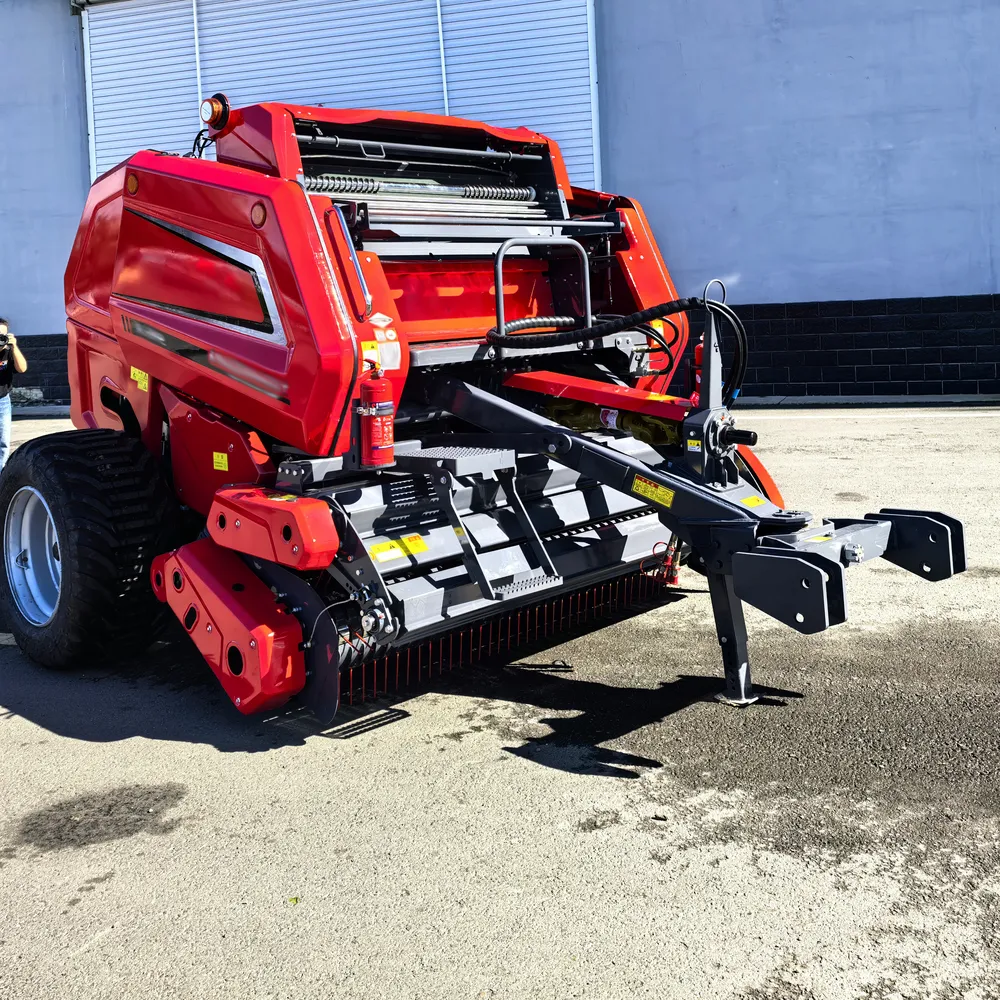
1. Pickup Reel Assembly
The 2200 mm wide spring-tooth pickup reel is the front-line crop gathering component. Hardened, heat-treated spring teeth penetrate the windrow, lifting material cleanly and conveying it rearward without wrapping or blockage. Hydraulic height adjustment from the tractor cab adapts the reel height instantly to crop density and ground conditions, protecting teeth from soil impact while maintaining clean crop collection even in thin, scattered windrows.
2. Continuous Screw Feeder
Positioned immediately behind the pickup reel, the continuous screw feeding mechanism actively centers and compresses the incoming crop stream before it enters the drum chamber. Unlike passive finger-bar feeders, the screw design maintains a consistent feed rate across varying windrow widths and prevents lateral material bunching that can cause uneven bale density. It is a critical component for achieving the uniform round bales that reduce post-harvest handling time at the feed yard.
3. Roll-Drum Bale Chamber
The fixed bale chamber is lined with 18 driven rollers, each Phi 222 mm in diameter, arranged to apply uniform radial pressure across the full 1400 mm chamber width. Unlike belt-type chambers, the rigid roller arrangement does not stretch or require replacing round baler belts over time, significantly reducing long-term maintenance cost. The 18-roller count provides superior grip on varied crop types, from slippery wet grass to coarse dry corn stalks, delivering consistently dense, weather-resistant bales at Phi 1220 mm finished diameter.
4. Net Wrap System
The net wrap dispenser holds a standard commercial roll of round baler wrap and feeds it across the finished bale surface under controlled tension while the precision loop counter tracks application cycles. An automatic net cutter severs the wrap cleanly after the preset number of loops is completed, eliminating manual cutting and the associated safety risk. The system is compatible with standard polyethylene net wrap rolls available globally, giving operators flexibility in material sourcing and cost management.
5. Hydraulic Tailgate and Ejection Ramp
The rear tailgate pivots upward on a dual-cylinder hydraulic actuator, opening the bale chamber fully for clean bale ejection. A controlled inclined ramp guides the finished bale down to the field surface at a safe angle, preventing the roll-away incidents that can damage bales or cause field hazards. Tailgate open and close time is optimized to minimize cycle dead-time, and robust hydraulic locks ensure the tailgate holds firm under the bale pressure that builds during the final phases of chamber filling.
6. PTO Driveline and Gearbox
The round baler PTO shaft and main gearbox transfer tractor power to all driven subsystems through a precisely engineered gear and chain transmission. The gearbox is sealed and oil-lubricated for long intervals between service. The PTO input is rated for continuous torque at 540 rpm, and overload protection is built into the driveline to shield the machine from shear forces caused by crop blockages. The complete drivetrain configuration is documented in the parts manual for straightforward parts sourcing worldwide.
7. Electronic Control Unit and Touchscreen
The brain of the 9YG-2.2 is a rugged field-rated electronic control unit (ECU) that continuously reads data from the displacement sensor, wrap loop counter, and hydraulic pressure transducers. The ECU communicates all status information to the handheld color touchscreen in the tractor cab in real time. Operators interact with the system through a purpose-designed graphical menu, setting bale weight targets, wrap counts, and notification thresholds without consulting printed manuals during field operation. Fault codes are stored and displayable for diagnostic purposes, accelerating round baler troubleshooting when a problem arises.
Round Baler vs. Square Baler: Which Is Right for You
The choice between a round baler vs. square baler remains one of the most consequential equipment decisions a farm operator faces. Both baler types compress cut crop into storable units, but the resulting bale shape, weight, handling method, and economics differ significantly. Understanding these differences helps you determine whether the 9YG-2.2 round baler or a square format better fits your operation.
| Round Baler | Square Baler |
| Bale Shape: Cylindrical, rolls easily by hand or loader tine; self-draining when stored in field. | Bale Shape: Rectangular, stacks flat for high-density warehouse storage; requires flat surface to prevent rolling. |
| Bale Size: Phi1220 mm x 1400 mm width at 3800 kg machine; typical bale weights 300~600 kg depending on crop and moisture. | Bale Size: Large square balers produce 0.9x1.2x2.4 m bales at 500~800 kg; small squares 20~40 kg for manual handling. |
| Tractor Requirement: 110~150 kW; one person can operate without a bale handler in the field. Suitable for how big of tractor for round baler queries: 150~200 HP tractors are the sweet spot. | Tractor Requirement: Large square balers need 130~200 kW tractors plus a bale chaser for transport; small squares 30~60 kW. |
| Crop Suitability: Excellent for silage round baler applications , net-wrapped bales ferment anaerobically; good for straw, hay, grass. | Crop Suitability: Superior for dry hay and straw destined for commercial sale; not commonly used for silage due to wrapping cost and complexity. |
| Capital Cost: Generally lower purchase price; simpler mechanical design with fewer round baler parts to replace annually. | Capital Cost: Large square balers command a significant premium; knotters and plunger mechanisms require skilled maintenance. |
| Labor:One-man operation; bales can remain in the field and be collected later. Suits small round baler for compact tractor scenarios where labor is scarce. | Labor: Large square bales require loaders and stackers; small square bale operations can be very labor-intensive for collection and stacking. |
| Storage:Cylindrical bales shed water naturally; wrap-protected bales can be stored outdoors for extended periods, reducing barn space requirements substantially. | Storage: Square bales stack efficiently in barns, achieving high storage density per cubic meter of covered space; exposed outdoor storage risks rapid quality loss. |
Common Round Hay Baler Troubleshooting
1. Bale Chamber Blockage
Symptom: PTO load spikes, machine decelerates, touchscreen alarm triggers. Cause: Excessive feed rate in heavy windrows, wet crop, or foreign material ingestion. Solution: Stop forward travel, disengage PTO, open tailgate and clear the blockage with a hook tool. Do not reach into the roller zone with hands. Resume at reduced tractor speed. Adjust pickup height upward if blockages recur frequently in the same field conditions.
2. Uneven or Loose Bale Shape
Symptom: Bales appear cone-shaped or noticeably softer on one side after ejection. Cause: Uneven windrow feeding, worn round baler rollers, or off-center screw feeder. Solution: Check that the screw feeder is centering material before the bale chamber. Inspect roller surface condition for flat spots. Verify tractor track width is centered on the windrow. In persistent cases, reduce forward speed and allow the screw feeder more time to center the crop stream before chamber entry.
3. Net Wrap Failure or Jamming
Symptom: Round baler wrap does not feed across the bale, wrapping cycle aborts, or net tears mid-application. Cause: Tangled net on dispenser, worn cutter blade, or net roll positioned incorrectly. Solution: Stop the machine safely, open the net wrap access panel, and clear any tangle by hand. Check that the new round baler wrap roll is correctly loaded with the free end positioned over the leading guide roller per the operator diagram. Replace the cutter blade if net ends are fraying rather than cutting cleanly.
4. Touchscreen or Sensor Error Codes
Symptom: Error code displayed on handheld screen; machine stops or refuses to start a new bale cycle. Cause: Displacement sensor wire disconnected, sensor face contaminated with crop residue, or ECU communication fault. Solution: Power cycle the ECU first. Then clean the displacement sensor face with a dry cloth and check connector security. Reference the error code table in the operator manual. If the fault persists after these steps, contact the service center with the exact error code for guided troubleshooting support.
5. PTO Shaft Vibration or Noise
Symptom: Unusual vibration felt through tractor hitch at PTO speeds, or rhythmic clunking sound during baling. Cause: Round baler PTO shaft universal joint wear, damaged telescopic spline section, or incorrect PTO connection angle. Solution: Stop and inspect the full length of the PTO shaft for joint play or damaged guards. Ensure the hitch drawbar is set to minimize operating angle, ideally below 15 degrees. Replace worn universal joints promptly to prevent sudden shaft failure during heavy baling operations in mid-field.
6. Hydraulic Tailgate Will Not Open
Symptom: Control signal issued to open tailgate but gate fails to move, or movement is slow and incomplete. Cause: Low hydraulic oil level, failed hydraulic valve solenoid, or internal cylinder seal leakage. Solution: Check hydraulic reservoir level first and top up if low. Verify that the tractor hydraulic output pressure meets the baler's minimum spec. Inspect solenoid valve wiring for corrosion at the connector. If cylinder drift is evident with the machine stationary, internal seal replacement is required; source OEM cylinder seal kits from the authorized parts network.
Round Baler and Round Baler PTO Shaft
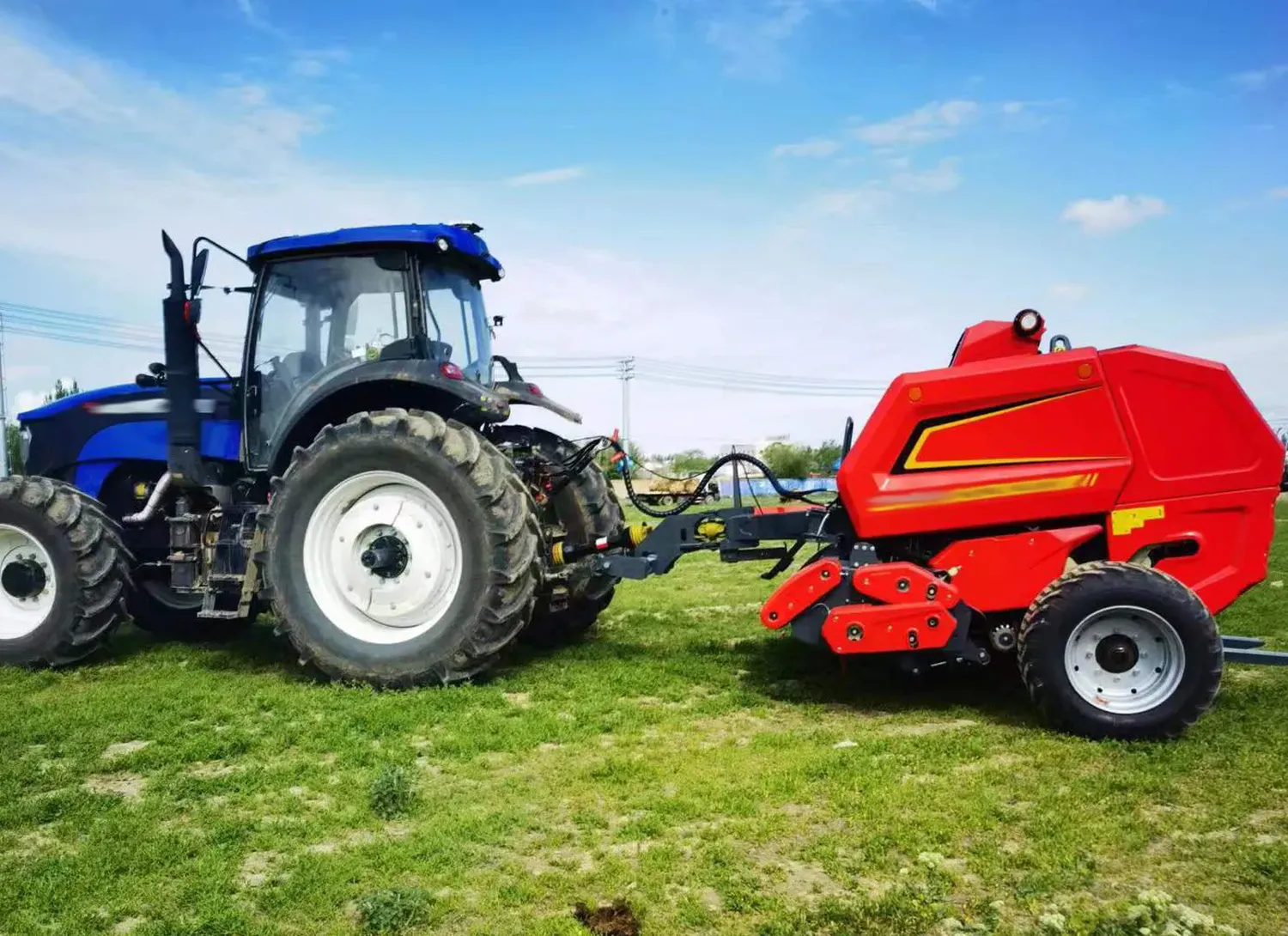
The round baler PTO shaft is the mechanical lifeline connecting the tractor's power take-off output to every driven component inside the 9YG-2.2 round baler machine. Without a properly specified, maintained, and safely guarded PTO shaft, even the most advanced round hay baler cannot function reliably in the field. The 9YG-2.2 is rated for tractors delivering 110~150 kW at the PTO output shaft, spinning at the standard 540 rpm agricultural PTO speed. This power is transmitted through the round baler PTO shaft , a telescoping, double-universal-jointed driveshaft fitted with overload shear protection and a full-length plastic guard, directly into the machine's input gearbox. The gearbox then distributes drive simultaneously to the pickup reel, continuous screw feeder, 18 compression rollers, net wrap dispenser drive, and the hydraulic pump. The round baler PTO shaft must therefore handle sustained peak torque loads, particularly during heavy windrow pickup and during the final stages of bale formation when chamber pressure is at its maximum.
Correct PTO shaft specification involves matching the shaft's rated torque capacity to the baler's demand, ensuring the telescoping tubes have sufficient overlap for the range of operating angles encountered as the tractor turns in the field. For the 9YG-2.2, the recommended round baler PTO shaft has a minimum 1.5x safety factor over the calculated maximum PTO torque at rated power, with wide-angle constant-velocity joints recommended where operators habitually operate with the baler at tight hitch angles in small paddocks or during headland turns.
Maintenance of the round baler PTO shaft directly affects both machine uptime and operator safety. Universal joints must be greased at intervals specified in the shaft manufacturer's service chart, typically every 8 hours of PTO-engaged operation in dusty or wet crop conditions. The telescoping spline section should be cleaned, greased, and verified for free movement before each season to prevent it from seizing in an extended position that cannot compress if the tractor reverses toward the baler. PTO shaft guards must be complete and attached at both the tractor guard chain hook and the baler input yoke bracket at all times, as an unguarded PTO shaft rotating at 540 rpm is one of the highest-severity hazards in agricultural machinery operation.
When sourcing a used baler or purchasing a new PTO shaft for a replacement, verify the shaft's input and output yoke profiles match the tractor PTO stub and baler input shaft profiles exactly , common sizes are 1-3/8 inch 6-spline (standard agricultural PTO) for 110 kW class tractors. Non-matching yoke profiles require adapter sleeves that reduce torque capacity and increase the risk of driveline failure under load. The PTO shaft is not a secondary accessory but a precision power delivery component deserving the same attention to specification and maintenance as any other critical drivetrain part in the machine.
FAQs
Q1: How big a tractor do I need for the 9YG-2.2 round baler?
A: The 9YG-2.2 requires a tractor with a continuous PTO output of 110~150 kW (approximately 148~200 HP). For sustained heavy-crop baling in corn stalks or thick grass swards, we recommend staying toward the top of that range. Tractors with 4-wheel drive are preferred for field stability and traction when towing the 3,800 kg machine through soft or wet field conditions. Always ensure the tractor's hydraulic output is sufficient to operate the baler's hydraulic circuit simultaneously.
Q2: Is the 9YG-2.2 suitable as a round baler for compact tractor or smaller farms?
A: The 9YG-2.2 is designed for mid-to-large scale operations requiring 110~150 kW. If you are looking for a small round baler for compact tractor with power below 80 kW, this specific model may not be the right fit. We offer smaller models in our range for compact tractors from 55 kW upward. Please contact our team to discuss the right baler size for your tractor and acreage. We will recommend the most cost-effective compact baler for your situation without oversizing the machine.
Q3: Can the 9YG-2.2 be used for silage baling, or is it only for dry hay?
A: Yes, the 9YG-2.2 is fully capable as a silage round baler. The net wrap bundling system seals the bale surface far more effectively than round baler twine, creating a near-anaerobic environment when the net-wrapped bale is subsequently covered with stretch film by a separate bale wrapper. This makes it ideal for high-moisture silage crops including grass, whole-crop corn, and sorghum. The drum-roller chamber handles wet, heavy crop without the belt slippage problems that can affect belt-type balers in silage conditions.
Q4: How does the 9YG-2.2 compare to belt-type balers , does it need replacing round baler belts?
A: The 9YG-2.2 uses a fixed roll-drum chamber with 18 steel rollers rather than a flexible belt system. This means there are no baler belts to replace , one of a key long-term cost advantage of roller-type machines over belt-type designs. Belts in competing balers can degrade and need replacement after intensive seasons, a costly and time-consuming workshop job. The 18 rollers in the 9YG-2.2 are built to last the life of the machine with proper lubrication and bearing maintenance.
Q5: What type of round baler wrap does the 9YG-2.2 use, and how many loops per bale?
A: The 9YG-2.2 uses standard polyethylene agricultural net wrap, the same net wrap rolls available from most agricultural supply outlets globally. Roll width should be 1400~1500 mm to match the 1400 mm chamber width. The number of wrap loops per bale is user-settable via the touchscreen, typically 2 to 3 loops for dry straw and 3 to 4 loops for silage crops requiring a tighter moisture seal. The high-precision loop counter ensures exact repeat accuracy, eliminating wrap overuse and improving per-bale cost control.
Q6: What are the round baler sizes and bale dimensions produced by this machine?
A: The 9YG-2.2 produces bales of Phi1220 mm diameter and 1400 mm width. These are large round baler dimensions typical of commercial-scale operations where subsequent mechanical handling with a tractor front loader or bale spike is the norm. Individual bale weight varies by crop type and moisture: dry wheat straw bales typically weigh 250~350 kg while corn silage bales at 60~65% moisture can exceed 550 kg. If smaller bale sizes are required for your farm, please inquire about our other models in the range.
Q7: Is the 9YG-2.2 a self propelled round baler or does it require a tractor?
A: The 9YG-2.2 is a towed-type round baler, not a self propelled round baler. It is hitched behind a conventional farm tractor via a standard drawbar and receives all its driving power through the tractor PTO shaft. Self propelled round baler models exist in the market but carry a significantly higher capital cost and are generally only justified in very large contract operations. For the vast majority of farm and custom baling operations, a high-quality towed round baler like the 9YG-2.2 delivers equivalent output at substantially lower investment.
Q8: How do I source round baler parts and what is the parts availability like?
A: We maintain a comprehensive round baler parts inventory for all models in our range, including the 9YG-2.2. Commonly requested items such as pickup teeth, chains, net cutter blades, bearing kits, and sensor modules are held in stock for fast dispatch. For international customers, parts can be shipped via express courier in 3 to 7 working days to most countries. The machine's design deliberately uses industry-standard chain sizes, bearing dimensions, and hydraulic fittings wherever possible so that emergency round baler parts can often be sourced locally even in markets where our distributor network is still developing.
Q9: What is the difference between round baler twine and net wrap, and which does the 9YG-2.2 use?
A: Round baler twine binds bales by wrapping cord over the bale ends in a criss-cross pattern, while round baler wrap (net) covers the entire bale surface in a continuous woven mesh. Net wrap produces a more weatherproof bale with lower surface losses over time, requires fewer wrapping cycles per bale than twine, and is faster to apply, reducing cycle time per bale. The 9YG-2.2 exclusively uses net wrap rather than round baler twine, which aligns with modern best practice for both hay and silage crop baling applications across the main global markets.
Q10: Can this round baler handle cotton stalks and sugarcane trash in addition to hay crops?
A: Yes. The 9YG-2.2 is designed specifically to handle a wide range of crop residues beyond traditional hay and straw. Cotton stalks, sugarcane tops, rice straw, and reeds have all been successfully processed by this machine in field operations across Asia, South America, and Africa. The key to success with abrasive or coarse residues is maintaining the automatic lubrication system in good condition and inspecting pickup teeth and chain wear more frequently than in standard hay baling applications. We can provide reference customer contacts in relevant regions if you need validation for your specific crop type before purchasing.

Customer Reviews
James Thornton, Grain Farmer, United States
"Bought the 9YG-2.2 about fourteen months ago for our corn and soybean operation in Iowa. We put it behind a 160 HP tractor and it just went to work from day one. The touch screen is honestly a lot easier than I expected, my son figured it out in half a day. Bale weight consistency on the corn stalks has been really good, all our bales hitting within a few percent of each other. We had a chain wear issue around month eight, called the service team, got the part shipped fast, back running in two days. Best round baler I have run in fifteen years of farming."
Roberto Salinas Vega, Livestock Farmer, Mexico
"I have been using this round baler for two seasons in my alfalfa and Bermuda grass pastures in Jalisco. Honestly, it exceeded my expectations. The automatic lubrication system means I don't have to worry as much during peak season, and the 18 rollers give an even shape to each bale. I requested a quote by email and they replied in less than 24 hours; the import procedures were clear. The truth is that compared to my previous baler, this one works much faster and with fewer stops. I recommend it for medium-sized ranches looking for a reliable round baler machine."
Harpreet Singh Dhaliwal, Wheat Farmer, India
"I was a bit skeptical about ordering a round baler from China but the pre-sale technical team were very thorough. They sent me a detailed spec sheet and walked me through tractor compatibility over video call. The 9YG-2.2 arrived well-packed and in good condition. Assembly on-site took our mechanic about two days. We have been baling wheat straw in Punjab for one full rabi season, probably 1,200 bales so far. Zero major breakdowns. The net wrap system is particularly good, much less waste than the twine baler we replaced. Shipping was maybe three weeks which was acceptable."
Brad Kellerman, Contract Farmer, Australia
"We operate a contract baling service in Queensland, rolling up sugarcane trash and sorghum stubble for biomass clients. The 9YG-2.2 has become our lead machine after just one season. The hydraulic pickup float is a genuine advantage in our uneven paddocks, it rides the ground without needing to constantly adjust height. We push the machine hard, sometimes twelve hours a day in the cane trash, and the auto lube system really earns its keep in those conditions. Had to replace two pickup teeth after hitting a chunk of steel in the field, part was sourced locally thanks to the common-standard fittings on this model."
Thierry Bonhomme, Cereal Farmer, France
"We bought two of these round balers for our grain farm in Beauce. Both machines have now been running for 18 months without any major issues. What I appreciate the most is the touch screen; my seasonal employees learn to use it in a few hours, which reduces training time. The 2200 mm pickup width is well-suited to our wheat straw windrows after harvesting. The bales come out perfectly round and dense, making them easy to store and transport. The after-sales service by email is reliable and fast, even during the harvest period. I recommend it without hesitation."
Marcelo Andrade Costa, Dairy Farmer, Brazil
"Running this round baler for silage on my dairy farm in Minas Gerais state. We bale tifton grass and corn silage with the 9YG-2.2 and the net wrap is tight and consistent on every bale. Bale diameter comes out at a reliable 1200~1220 mm which makes stacking and handling predictable for my team. I was a little worried about support distance when I ordered, but they have a Brazilian distributor now who has parts in stock. Delivery logistics were smooth, container arrived in Santos port in good time. Machine build quality looks solid, much better than photos suggested honestly. Very happy three seasons in."
Aleksandr Morozov, Rice and Grain Farmer, Russia
"We farm rice in the Krasnodar region and use the 9YG-2.2 to bale rice straw after combine. Rice straw is tricky, it is wet, short, and likes to bridge inside cheaper machines. This one handles it well thanks to the continuous screw feeder, we rarely get blockages now. We got the machine last spring and have done roughly 800 bales so far. After 500 hours the chain tension needed adjusting but otherwise nothing major. The centralized grease system saves a lot of time versus our old baler where you had to grease maybe twenty separate points. Overall good value for the spec you get."
Kevin Macdonald, Grain Farmer, Canada
"Bought this unit after comparing several baler manufacturers online. The spec sheet was honest and everything matched when the machine arrived. I run it behind a 175 HP Case IH on our wheat and barley farm in Saskatchewan. First season we baled about 2,400 straw bales without a single unplanned stop, which for a brand new piece of equipment is honestly impressive. The auto mode works great, I barely have to touch the touchscreen once I set my bale weight target at the start of the day. Shipping to Canada took a bit longer than expected but the agent kept me updated the whole time. Would buy again."
Diego Fernandez Ramos, Cattle Producer, Argentina
"We operate a livestock farm in Entre Rios province where we bale pasture grass and alfalfa for our beef herd. I had been using a locally sourced round hay baler machine that was always breaking down. A colleague recommended this brand. We have had the 9YG-2.2 for two full seasons now, both years without major issues. The after-sales team answered my WhatsApp questions quickly even on weekends which matters a lot when you are in the middle of harvest. Bale shape is very uniform, which helps when feeding out from a round bale feeder to the cattle. Machine arrived earlier than quoted. Very satisfied overall."
Additional information
| Edited by | Yjx |
|---|