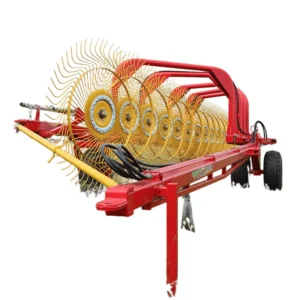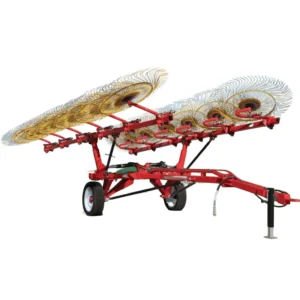
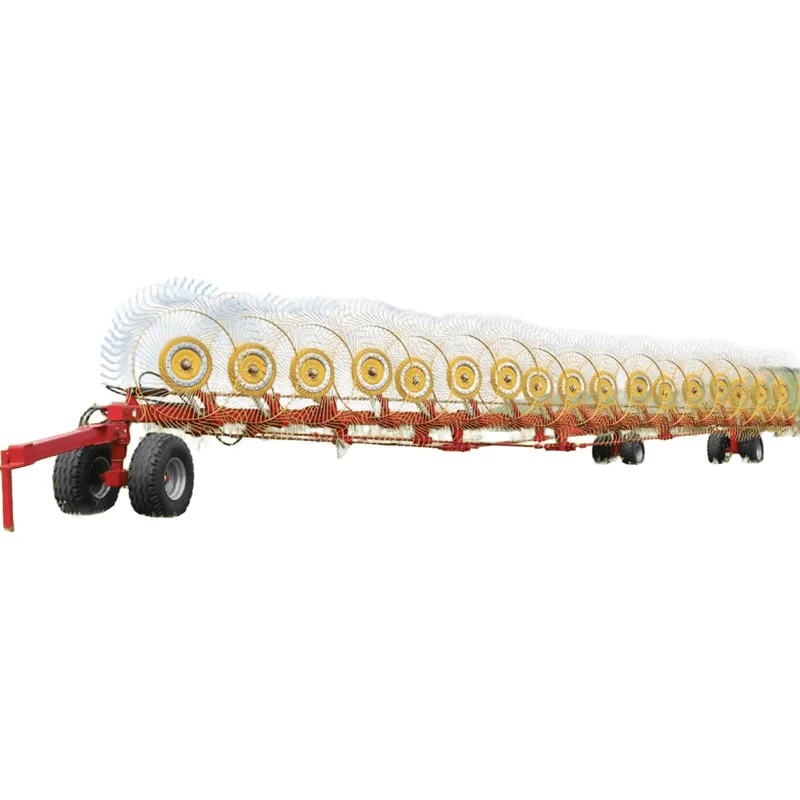
9LZD-9.0 Finger Wheel Rake for Tractors
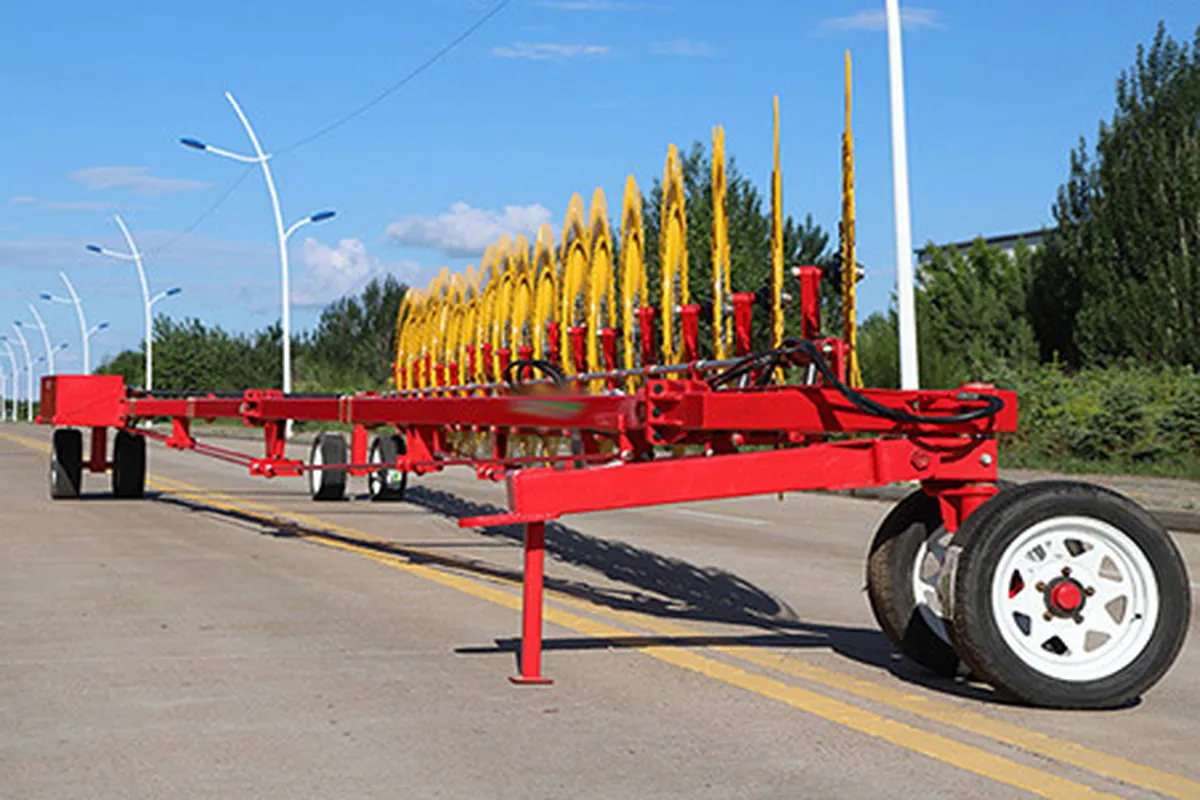
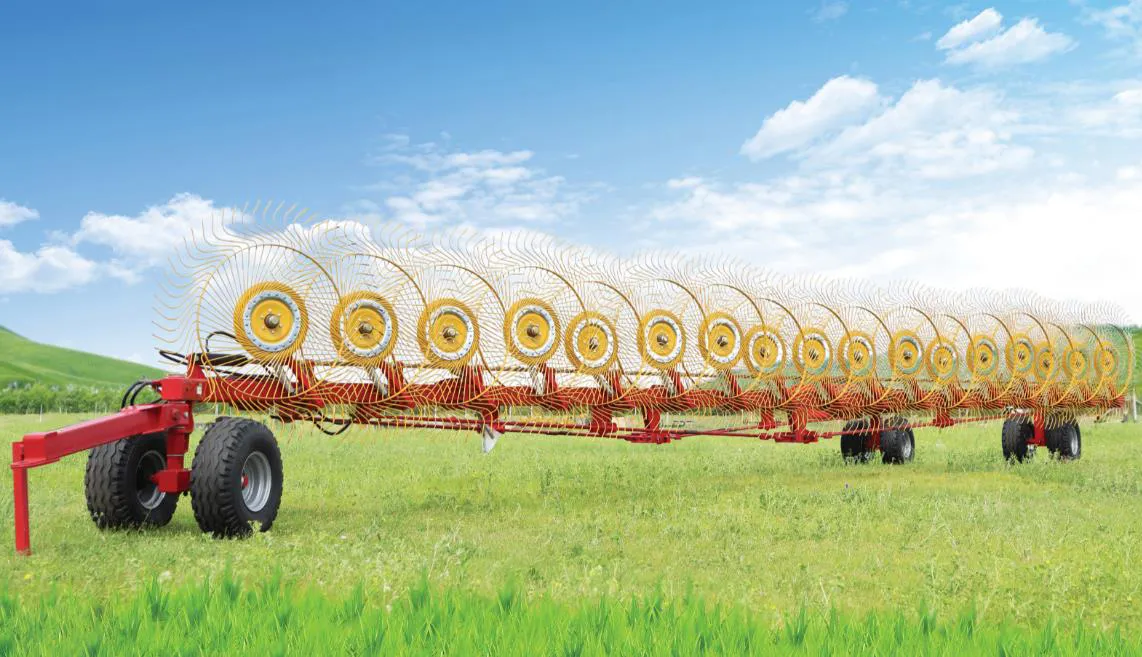
The 9LZD-9.0 finger wheel rake (17 discs) is towed by a 55-75KW (75-102 horsepower) wheeled tractor for operation. It is a post-harvest processing machine for forage straw. It can stack and integrate the cut and sun-dried forage and straw into strips, and also turn and dry them in rows. This product is suitable for the pile collection operation of forage and straw in pastoral and agricultural areas. It features a wide working range, high production efficiency, simple structure, convenient operation, safety and reliability, uniform pile collection of grass strips with good air permeability, and the lifting of the pile grass finger plate is all controlled by a hydraulic system.
9LZD-9.0 Finger Wheel Rake Overview
The 9LZD-9.0 finger wheel rake (17 discs) is towed by a 55-75KW (75-102 horsepower) wheeled tractor for operation. It is a post-harvest processing machine for forage straw. It can stack and integrate the cut and sun-dried forage and straw into strips, and also turn and dry them in rows. This product is suitable for the pile collection operation of forage and straw in pastoral and agricultural areas. It features a wide working range, high production efficiency, simple structure, convenient operation, safety and reliability, uniform pile collection of grass strips with good air permeability, and the lifting of the pile grass finger plate is all controlled by a hydraulic system.
Product Specifications
| No. | Item | Unit | Specifications |
|---|---|---|---|
| 1 | Model Name | / | 9LZD-9.0 Finger-wheel Rake |
| 2 | Structure Type | / | Finger-wheel type |
| 3 | Hitching Method | / | Trailed / Towed type |
| 4 | Model Specification | / | 9LZD-9.0 |
| 5 | Matched Power | kW | 55-75 |
| 6 | Overall Dimensions (Working State) | m | (L×W×H) 16.8×3.9×1.6 |
| 7 | Machine Weight | kg | 1240 |
| 8 | Working Width | m | 9 |
| 9 | Working Speed | km/h | 8-10 |
| 10 | Transport Speed | km/h | 12 |
| 11 | Number of Finger-wheels | pcs | 17 |
| 12 | Number of Tines | pcs | 1020 (17 wheels × 60 tines/wheel) |
| 13 | Number of Operators | person | 1 |
| 14 | Windrow Width | m | 0.8-1.2 |
| 15 | Raking Loss Rate | % | ≤2% |
| 16 | Productivity | h m²/h | 7.2-9 |
9LZD-9.0 Finger Wheel Rake Benefits
1. High Efficiency and Wide Working Range
The 9LZD-9.0 finger wheel rake is designed to cover a wide working range, making it highly efficient for large-scale operations. Its ability to handle vast areas in less time significantly improves productivity, reducing the workload for farmers while maintaining consistent and uniform results.
2. Uniform Pile Collection with Excellent Air Permeability
This machine ensures uniform grass strip collection, which is essential for optimal drying and storage. The piles it creates have excellent air permeability, allowing for better circulation during the drying process. This feature prevents spoilage, ensuring higher quality forage or straw for future use.
3. Hydraulic System for Convenient Operation
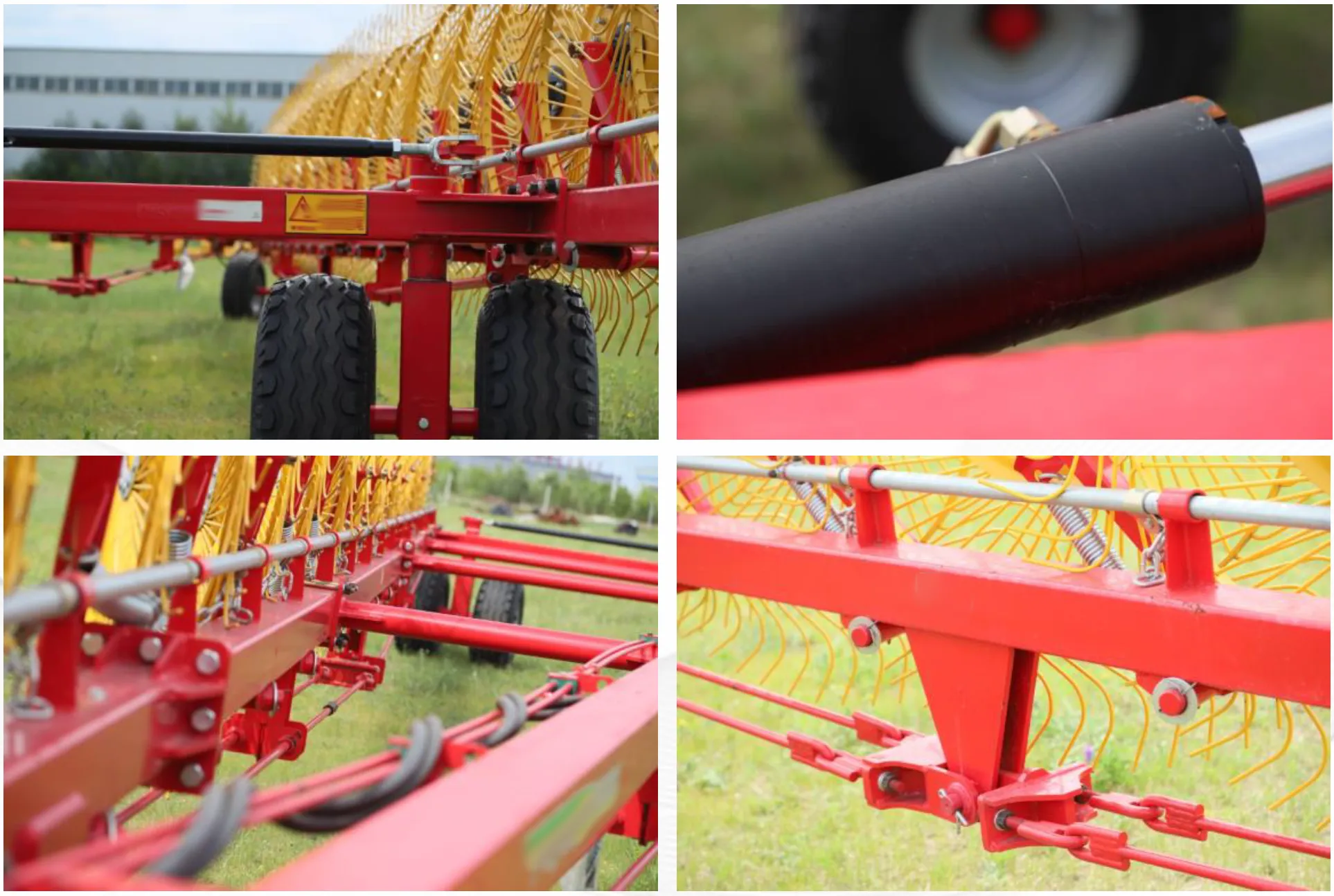
The advanced hydraulic system enables precise control over the lifting and lowering of the finger plates. This not only improves the safety and reliability of the machine but also allows farmers to operate it with ease, reducing physical strain and operational complexity.
4. Robust and Simple Structure for Durability
Built with a simple yet sturdy structure, the 9LZD-9.0 is designed for long-term durability under demanding working conditions. Its robust components require minimal maintenance, making it a cost-effective solution for farmers seeking reliable performance over extended periods.
5. Versatility in Agricultural and Pastoral Use
The rake is suitable for various applications, including stacking, turning, and integrating forage and straw in rows. Its versatility makes it an essential tool for both agricultural and pastoral areas, meeting the diverse needs of different farming environments with ease.
6. Enhanced Safety and Reliability
Safety is a priority in the 9LZD-9.0 design, with features like controlled hydraulic lifting ensuring secure and reliable operation. This minimizes risks during use and ensures that the machine remains dependable, even in challenging field conditions, giving farmers peace of mind.
Finger Wheel Hay Rake Applications
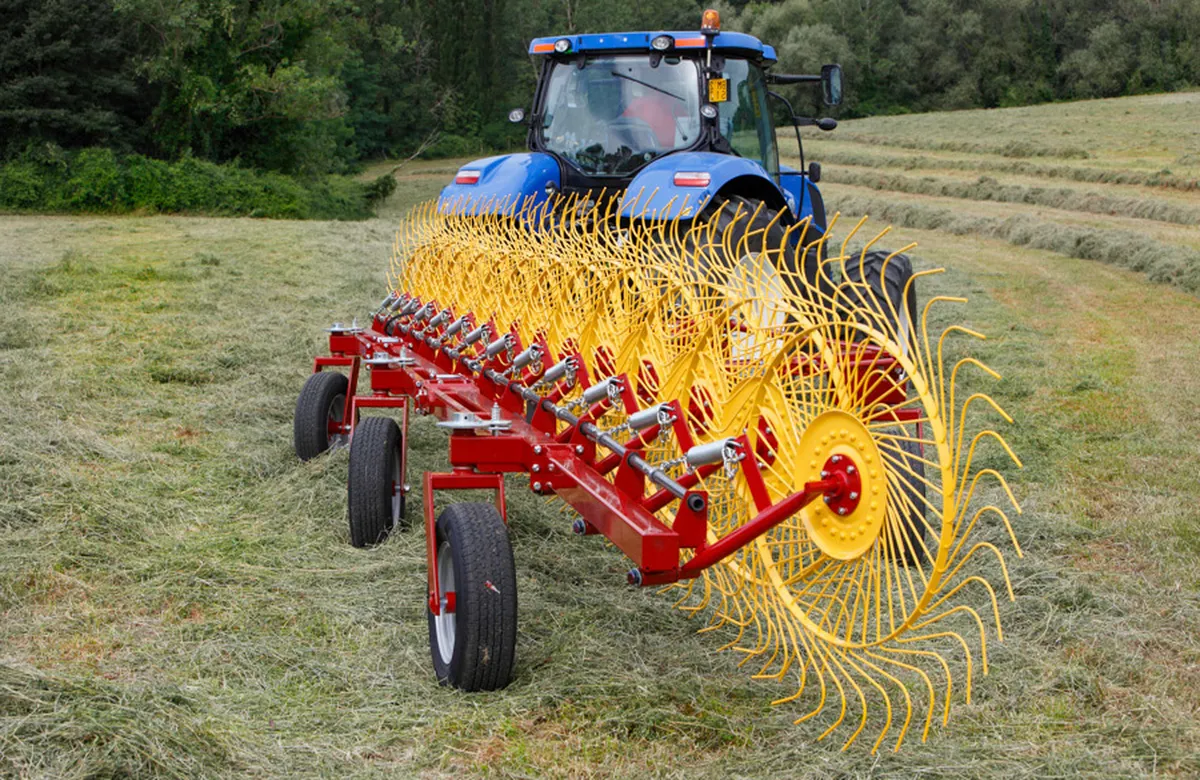
The finger wheel hay rake is an essential agricultural tool designed to streamline the process of handling forage and straw after harvest. Its primary application is in the collection, turning, and piling of cut and sun-dried forage or straw into neat rows, which is critical for proper drying, storage, and subsequent processing. This machine provides a versatile solution for various farming operations, making it indispensable in both pastoral and agricultural settings.
One of its key applications is in the collection of forage material, such as alfalfa, grass, or straw, after mowing. By raking the material into uniform strips, the machine ensures that the forage is aerated and exposed to sunlight, promoting faster and more even drying. This is particularly important for maintaining the quality of forage, as proper drying reduces the risk of mold development and enhances the nutritional value of the harvested material.
The finger wheel hay rake is also widely used for turning and fluffing forage piles. By lifting and redistributing the material, the rake improves airflow and accelerates the drying process. This helps farmers achieve optimal moisture levels, which is crucial for safe storage and long-term preservation of hay or straw. Additionally, the machine’s ability to handle large volumes of forage in a single pass makes it highly efficient, saving both time and labor costs during post-harvest operations.
In agricultural regions, the rake is commonly employed for straw collection after grain harvesting. It neatly arranges the straw into rows, making it easier to bale and transport. In pastoral areas, it is widely used for preparing forage for livestock feeding, ensuring that the material is clean, dry, and easily accessible.
Other Types of Hay Rake
1. Dump Rake
The dump hay rake gets its name because the hay rows it creates run perpendicular to the machine’s direction. Its structure is simple. It mainly consists of a straw rake, a lifting mechanism, and a frame. The rake features a row of horizontally parallel teeth. These teeth can be circular or spiral-shaped. The shape of the teeth affects the rake’s effectiveness and quality in collecting grass strips. The spacing between the teeth usually ranges from 7 to 9 millimeters. Smaller spacing helps grass strips stack more compactly. Larger spacing is suitable for thicker grass.
Working Principle
When the dump hay rake moves forward, the spring teeth lift the grass from the bottom along its curved surface, raising it to the highest point before it falls down to form a hay row. Once the row fills the front part of the teeth, the lifting system can raise the rake. Then, using the weed bar, the gathered hay is dropped to the ground, forming a hay row about the same length as the working width of the rake. After that, the rake automatically lowers and continues gathering hay.
Application
The dump hay rake works at a slower speed, usually 4 to 5 kilometers per hour. Unlike the wheel-type rake, you can adjust the size of the hay rows it creates. If your field is small or the grass yield is not very high, a dump hay rake will be enough for your needs.
2. Rotary Rake
You can divide the rotary hay rake into two types based on its components: the rake type and the spring-tooth type. The rotary hay rake has 6 to 8 rakes on each rotating part, while the spring-tooth type has several spring teeth around the rotating parts.
A rotary hay rake mainly consists of the frame, drive system, rotating body, wheels, rear deflector, and raking parts (either spring teeth or rakes).
The wheels support the machine and help it move on the ground, making it easier to operate. You can adjust the rear deflector to change the working width based on the amount of grass. The raking parts on the rake arms work with the deflector to gather the grass and straw.
Working Principle
As the tractor moves forward, the ground wheels also move, and the hay rake begins to work. The rake teeth rotate around a central axis while also spinning on their own. The cam track and cam cover limit the teeth, making them rotate along a fixed path and angle. This design makes sure the rake teeth accurately gather the hay in a specific spot and can also flip the hay.
The working principle of the rotary hay rake is simple. When the rotating parts spin, centrifugal force makes the spring teeth open, performing the raking action. To spread the hay, you need to change the angle at which you install the spring teeth.
Application
The rotary hay rake works quickly, with speeds of 12 to 18 kilometers per hour. It gathers the hay into loose, airy rows, which helps the grass dry thoroughly and shortens the drying time, resulting in higher-quality hay bales. If you have a large field with a high yield, a rotary hay rake would be a good choice.
3. Drum Rake
The main working component of a drum hay rake is a rake drum that rotates around a horizontal axis. The drum is composed of 3 to 6 parallel toothed rods with rows of rake teeth. The two ends of the toothed rods are connected to two parallel ones on the circular plane of the drum, forming a parallelogram structure. Therefore, during the rotation of the drum, the direction of the teeth always remains parallel to each other.
Working Principle
When the drum hay rake works, the tractor’s power take-off shaft will drive the drum and then the drum starts rotating. As the machine moves forward, the raking spring teeth also rotate around a horizontal axis. When the grass and straw come into contact with the spring teeth, they form continuous hay rows between the two drums, aligned with the direction the machine is moving.
Application
The drum hay rake can work at speeds of 12 to 18 kilometers per hour. The dense spring teeth on the two drums effectively gather the dry hay and reduce waste. As the drums rotate, the spring teeth move in a sweeping motion, keeping the hay rows loose and airy. If you have a large field with a high yield and need high-quality hay rows, the cylinder hay rake would be a good choice.
Maintenance Tips for Finger Wheel Rakes
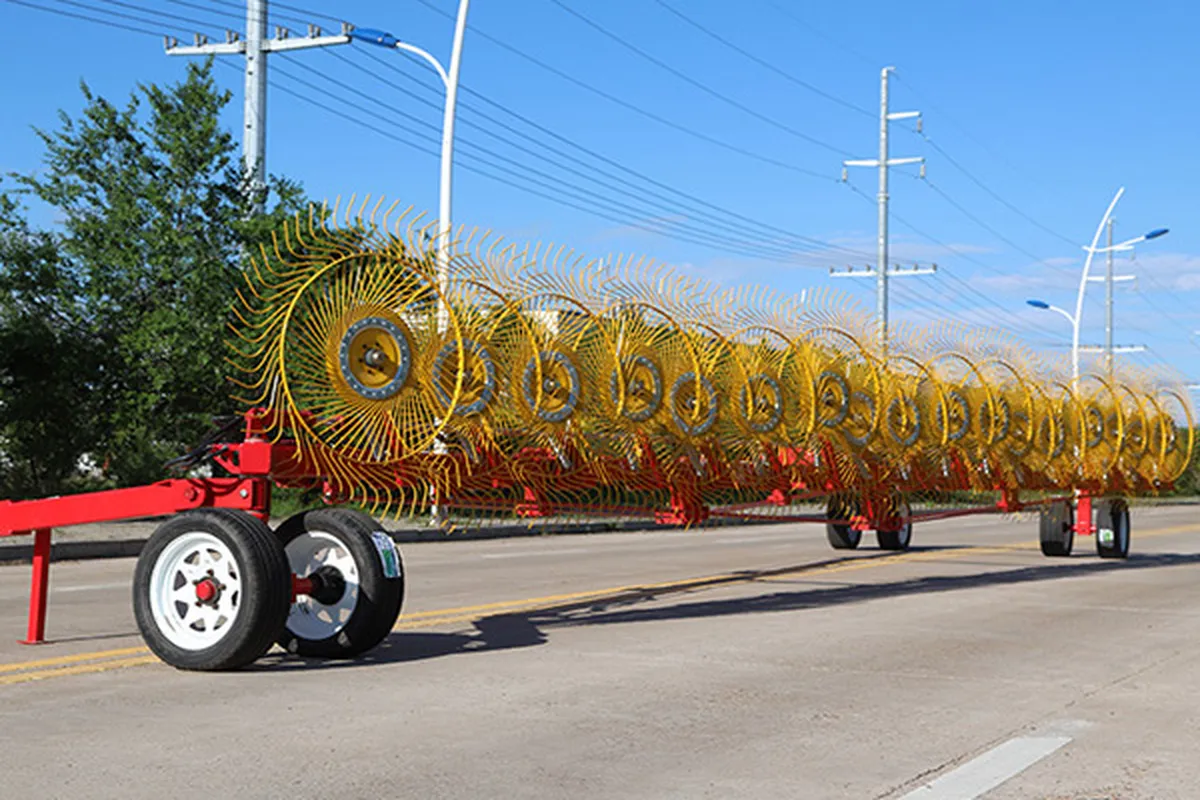
Proper maintenance of a finger wheel rake is essential to ensure its optimal performance, extend its lifespan, and reduce downtime during critical farming operations. By following these maintenance tips, you can keep your equipment in excellent working condition while minimizing repair costs.
Regular Cleaning
After each use, thoroughly clean the finger wheel rake to remove dirt, debris, and plant material that may accumulate on the wheels, tines, and frame. Residue buildup can cause rust and reduce the effectiveness of the rake. Use a brush, compressed air, or water to clean hard-to-reach areas, ensuring no material is left behind.
Inspect Tines and Wheels
Regularly inspect the tines and wheels for wear, bending, or breakage. Damaged tines can reduce the rake’s ability to collect forage effectively, while worn wheels may cause uneven operation. Replace any damaged or excessively worn components promptly to maintain optimal performance.
Lubricate Moving Parts
Proper lubrication of all moving parts, such as wheel hubs, bearings, and pivot points, is critical. Apply high-quality grease or lubricant at recommended intervals, as specified in the manufacturer’s manual, to prevent wear and ensure smooth operation.
Check Hydraulic Systems
For rakes equipped with hydraulic lifting systems, inspect hoses, connections, and cylinders for leaks or damage. Ensure the hydraulic system is functioning correctly and that the fluid levels are adequate to avoid operational issues during use.
Tighten Bolts and Connections
Vibrations during operation can loosen bolts and fasteners over time. Periodically check and tighten all connections to prevent parts from loosening or detaching, which could compromise safety and functionality.
Store Properly
When not in use, store the finger wheel rake in a dry, sheltered location to protect it from moisture and weather damage. If storing outdoors, cover the equipment with a durable tarp to prevent rust and deterioration.
FAQs
Q: What is the recommended tractor power for the 9LZD-9.0 finger wheel rake?
A: The 9LZD-9.0 finger wheel rake is designed to be towed by wheeled tractors with a power range of 55-75KW (75-102 horsepower). This ensures the machine operates efficiently, delivering consistent results in various field conditions without overloading the tractor.
Q: What are the primary uses of the 9LZD-9.0 finger wheel rake?
A: This rake is primarily used for post-harvest operations such as collecting, turning, and piling forage and straw into neat rows. It facilitates drying, stacking, and eventual baling, making it suitable for agricultural and pastoral applications involving hay, straw, and forage.
Q: How does the hydraulic system improve operation?
A: The 9LZD-9.0 is equipped with a hydraulic system that controls the lifting and lowering of the finger plates. This enhances operational convenience, allowing precise adjustments during use. It also improves safety and efficiency by reducing manual intervention and ensuring smooth, controlled movements.
Q: What makes this rake suitable for forage drying?
A: The rake arranges forage into uniform strips with excellent air permeability, which promotes even drying. This prevents mold formation, preserves the nutritional content of the forage, and ensures that the material is ready for storage or feeding in optimal condition.
Q: How many discs does the 9LZD-9.0 rake have?
A: The rake is equipped with 17 discs, which provide a wide working range and high efficiency. This design enables it to handle large volumes of forage or straw in a single pass, minimizing the time and effort required for post-harvest operations.
Q: Is the 9LZD-9.0 rake easy to operate?
A: Yes, the rake features a simple structure and user-friendly controls, making it easy to operate even for individuals with minimal experience. The hydraulic system further simplifies adjustments, ensuring that the machine delivers consistent performance under varying conditions.
Q: What types of materials can the rake handle?
A: The 9LZD-9.0 is versatile and can handle a range of materials, including alfalfa, grass, hay, wheat straw, and other types of crop residue. Its robust design ensures efficient handling without compromising the quality of the materials being processed.
Q: How durable is the 9LZD-9.0 finger wheel rake?
A: Built with high-quality materials and a sturdy frame, the rake is highly durable and capable of withstanding demanding field conditions. Proper maintenance ensures long-term reliability, making it a cost-effective investment for farmers.
Q: Can it handle uneven terrain?
A: Yes, the 9LZD-9.0 performs well on uneven terrain due to its robust design and flexible wheel configuration. The rake adapts to ground contours, ensuring consistent results even in fields with irregular surfaces, hills, or slopes.
Q: What are the benefits of using the 9LZD-9.0 rake compared to manual methods?
A: The rake drastically reduces the time and labor required for post-harvest operations. Its efficiency, wide working range, and ability to create uniform rows improve productivity while ensuring higher-quality forage. This makes it a valuable tool for modern farming practices.
Customer Reviews
United States Customer:
“The 9LZD-9.0 Finger Wheel Rake has been a game-changer for my farm. Its ability to collect and turn hay into perfectly uniform windrows has significantly improved drying efficiency. The hydraulic control system is smooth, intuitive, and easy to use, and the machine’s durability ensures it can handle the demands of large-scale farming operations.”
France Customer:
“In France, where quality forage is critical, this rake has exceeded expectations. The uniformity of the windrows ensures even drying, preserving the nutritional quality of the hay. It is easy to operate and maintain, and it performs well in varying field conditions, saving time and labor.”
Australia Customer:
“This rake has been ideal for our dry and rugged Australian conditions. The wide working range and robust design ensure it can handle large fields with ease, even on uneven terrain. It has vastly reduced the time required for hay collection and has proven to be incredibly reliable and efficient.”
Brazil Customer:
“The 9LZD-9.0 is perfect for our needs in Brazil. It handles large quantities of forage effortlessly, and the uniform windrows it creates make baling so much easier. The hydraulic system is a standout feature, offering precise control. It’s a tremendous investment for farmers with large-scale operations.”
Canada Customer:
“Our Canadian farm has benefited significantly from the 9LZD-9.0. The machine handles wet and dry conditions equally well, and the air permeability of the rows it creates ensures faster drying. Its sturdy construction and smooth operation make it a reliable partner for our hay and straw collection needs.”
Netherlands Customer:
“This rake is perfect for the high-quality forage production we focus on in the Netherlands. The machine is efficient, creating rows that are easy to bale and store. The hydraulic lifting system works flawlessly, and its low maintenance needs make it a practical and valuable addition to our equipment.”
Germany Customer:
“The 9LZD-9.0 stands out for its engineering quality, a feature we highly value in Germany. It’s robust, efficient, and handles straw and forage exceptionally well. The precision of the hydraulic control system makes it easy to operate, and its performance in large fields is truly impressive.”
Russia Customer:
“Farming in Russia can be challenging due to tough terrain and weather, but the 9LZD-9.0 Finger Wheel Rake handles it all brilliantly. Its strong frame and adaptability to uneven fields are impressive. The machine saves so much time during harvest, and its performance is consistent and dependable.”
India Customer:
“The 9LZD-9.0 has transformed our post-harvest operations in India. It handles straw and forage efficiently, even on small and irregularly shaped fields. The hydraulic system is straightforward to use, and the machine’s ability to create uniform rows ensures faster drying, improving the overall quality of our hay.”
Lisätiedot
| Edited by | Yjx |
|---|